
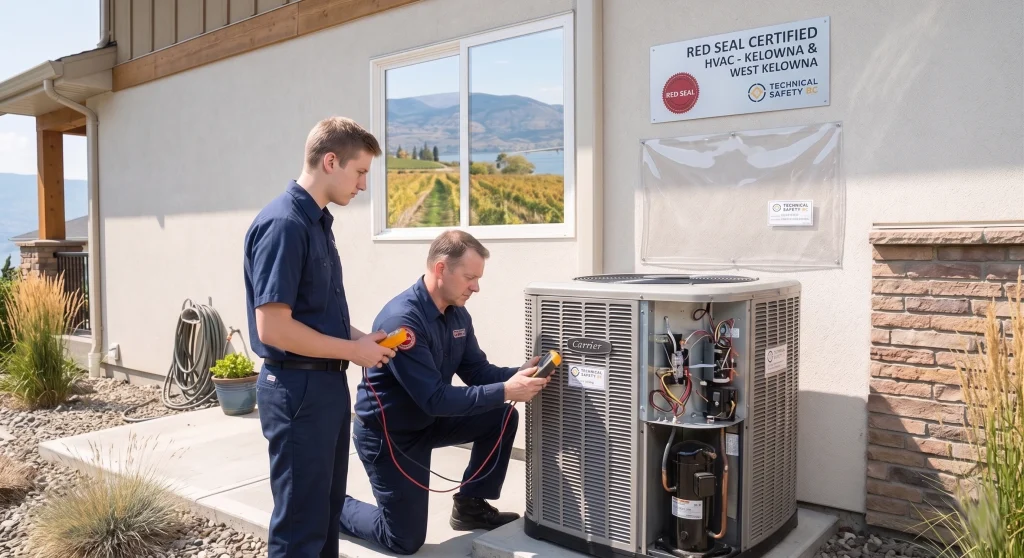
Kelowna and West Kelowna experience severe summer heat waves exceeding 35°C, making reliable residential cooling essential for occupant safety and structural climate control. This technical guide outlines the precise verification protocols required to vet local HVAC mechanical contractors. It provides an actionable spring preventative maintenance checklist to optimize cooling system efficiency and mitigate peak-season mechanical failures.
Technical Credentials for Cooling Infrastructure Technicians
Technical credentials determine the competency, legality, and safety metrics of individuals executing mechanical repairs on residential cooling equipment. Due to the high thermodynamic loads placed on cooling infrastructure in the Okanagan Valley, precise mechanical execution is mandatory.
Air Conditioning Repair Kelowna
Air Conditioning Repair Kelowna refers to the technical diagnostic, restoration, and optimization procedures performed on malfunctioning or inefficient cooling systems within the city of Kelowna. When system failures occur during periods of high ambient temperature, property owners must secure qualified field technicians to restore refrigeration cycles. Selecting a service provider requires verifying individual technician qualifications rather than relying solely on corporate marketing claims.
AC Repair West Kelowna
AC Repair West Kelowna denotes the specialized mechanical interventions required to resolve central air conditioning, ductless mini-split, and heat pump malfunctions within the municipality of West Kelowna. The regional microclimate requires systems to operate continuously under high head pressures. Competent diagnostic resolution requires advanced knowledge of electrical fault-finding, airflow dynamics, and thermodynamic principles.
Verification Matrix for Mechanical Contractors
To guarantee compliance with provincial safety standards and ensure technical proficiency, homeowners must audit prospective service providers against the following credential framework:
| Credential Type | Issuing Authority | Technical Scope and Legal Significance |
|---|---|---|
| Technical Safety BC Licence | Technical Safety BC (TSBC) | Mandatory legal authorization required to perform regulated electrical, gas, and refrigeration work in British Columbia. Verifies the business carries active bonds and permits. |
| Red Seal Certification | SkilledTradesBC / Canadian Council of Directors of Apprenticeship | Indicates the technician has completed a four-year apprenticeship and passed the interprovincial exam for the Refrigeration and Air Conditioning Mechanic trade. |
| Refrigerant Handling Certification | Environment Canada / Province of British Columbia | Certifies compliance with the Federal Halocarbon Regulations to legally purchase, handle, and recover ozone-depleting substances and fluorocarbon alternatives. |
| FSR Designation | Technical Safety BC | Field Safety Representative status. Confirms the individual can obtain electrical permits and certify that regulated cooling control wiring meets the BC Electrical Code. |
Regional Industry Landscape and Firm Selection
The HVAC service market in the Okanagan region consists of numerous enterprises offering installation and restoration services. Differentiating between these entities requires systematic analysis of licensing status and service capabilities.
Air Conditioning Companies Kelowna
Air Conditioning Companies Kelowna encompasses the collective group of commercial enterprises operating within the Kelowna municipal boundaries that provide cooling system design, engineering, installation, and maintenance services. Homeowners must differentiate between comprehensive mechanical firms and unlicenced handymen. Valid companies must display their active Technical Safety BC contractor licence number on service vehicles and marketing materials.
Air Conditioning Companies West Kelowna
Air Conditioning Companies West Kelowna defines the network of HVAC contractors servicing the west side of Okanagan Lake. Because of geographic positioning, these companies must possess logistical capabilities to handle rapid-response emergency dispatches across the William R. Bennett Bridge during peak-season heat waves.
Method for Vetting HVAC Providers
- Query the Technical Safety BC Registry – Input the contractor’s corporate name into the active TSBC license database to verify status and ensure no active safety discipline notices exist.
- Confirm Red Seal Staffing Ratios – Demand confirmation that the dispatched field technician holds a journey-person Red Seal certificate or is a registered apprentice working under direct on-site supervision.
- Verify General Liability and WorkSafeBC Compliance – Request proof of minimum 2,000,000 CAD commercial general liability insurance and a current WorkSafeBC clearance letter to eliminate homeowner liability for on-site workplace injuries.
- Evaluate Diagnostic Fee Structures – Avoid firms utilizing flat-rate pricing models that omit transparent breakdowns of labor hours and material costs. Professional companies supply itemized estimates prior to component replacement.
Spring Preventative Maintenance Checklist
Preventative maintenance executed prior to June minimizes component stress, lowers energy consumption, and reduces the statistical probability of system breakdown during 35°C ambient temperature thresholds.
Condenser Coil Sanitation
Condenser coils facilitate the rejection of heat from the indoor space to the outdoor environment. Cottonwood seeds, dust, and environmental debris accumulate on aluminum fins, creating an insulating barrier that restricts heat transfer.
- Action – Isolate the electrical supply via the outdoor disconnect box. Apply a specialized, non-acidic chemical coil cleaner to the exterior matrix. Allow the solution to penetrate the debris, then perform a low-pressure wash from the inside out to avoid bending the aluminum fins.
Evaporator Coil Inspection
The indoor evaporator coil absorbs thermal energy from the household air supply. Restricted airflow across this component leads to structural ice formation and liquid refrigerant flood-back to the compressor.
- Action – Remove the access plenum panel to inspect the coil face. If biological growth or dust accumulation is present, use a soft-bristled brush and self-rinsing evaporator cleaner to remove the restriction.
Refrigerant Mass Analysis
Air conditioning systems operate on a closed loop utilizing specific factory refrigerant charges measured in ounces or kilograms. Incorrect refrigerant levels lower system capacity and cause premature compressor failure.
- Action – A Red Seal technician must attach digital manifolds to measure subcooling and superheat metrics. This calculation determines if the system has a low charge indicating a physical leak, or an overcharge scenario that threatens mechanical components.
Electrical Component Diagnostics
High ambient temperatures increase resistance within electrical control circuits, accelerating the degradation of capacitors and contactor points.
- Action – Measure capacitance values of the dual-run capacitor using a multimeter set to microfarads ($\mu\text{F}$). Components reading more than 10% below nominal rating require proactive replacement. Inspect contactor points for pitting or carbon scoring.
Air Filtration Optimization
Air filters remove particulate matter to maintain indoor air quality and protect the internal surface area of the evaporator coil.
- Action – Replace standard pleated filters before the onset of summer. Select a Minimum Efficiency Reporting Value (MERV) rating between 8 and 11 to ensure proper particulate capture without creating excessive static pressure drops across the blower motor.
Frequently Asked Questions
Property owners can verify contractor legitimacy by utilizing the “Find a Licensed Contractor” tool on the Technical Safety BC online portal. Entering the business name or licence number will confirm if the company holds an active Refrigeration Class REF or Electrical licence, which is required to legally pull permits and execute cooling system alterations in British Columbia.
Operating a system with a compromised condenser coil restricts thermal rejection. This forces the compressor to operate at elevated head pressures and high internal temperatures. This scenario increases energy draw, degrades lubricating oil, accelerates mechanical wear on internal valves, and triggers thermal overload shutdowns.
The Red Seal designation indicates an installer has completed 7,200 hours of standardized provincial training and technical schooling. This background ensures the technician can properly calculate electrical loads, handle regulated fluorocarbon gases safely, evaluate airflow physics, and accurately diagnose complex refrigeration system faults.
Refrigerant circuits are sealed systems that do not consume fluid. A comprehensive professional evaluation including subcooling and superheat analysis should occur annually during spring maintenance. If a system requires frequent refrigerant top-ups, a leak test must be executed to identify and repair the physical breach in compliance with BC environmental regulations.
A MERV rating between 8 and 11 is optimal for standard residential systems. Filters within this range trap pollen, smoke particles, and dust without causing severe restrictions in system airflow. Utilizing a MERV 13 filter or higher in a system not engineered for high static pressure can cause the indoor evaporator coil to freeze, stopping the cooling process entirely.