
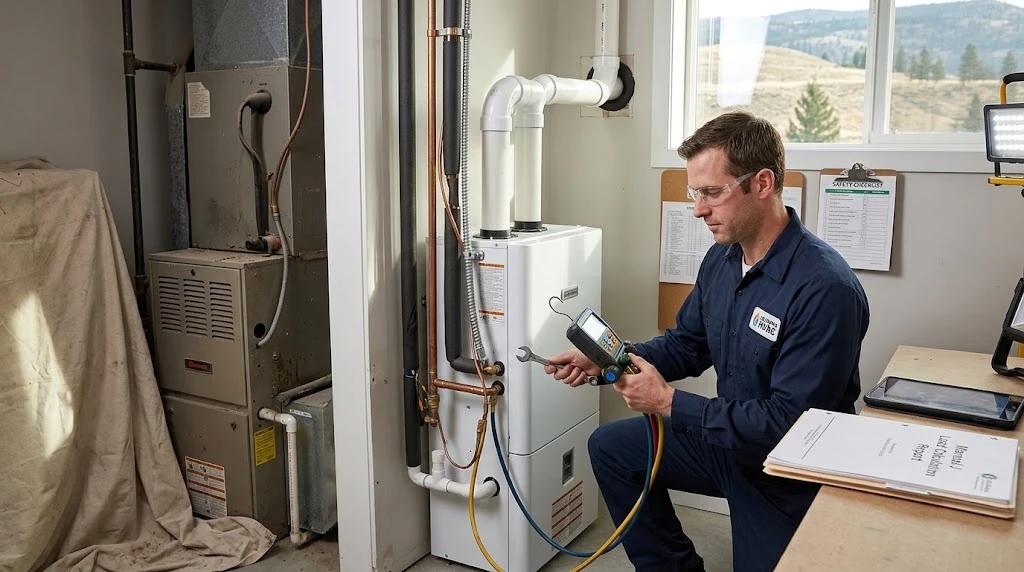
Key Takeaways: Furnace replacement in Kelowna and West Kelowna requires evaluating system lifespan, calculating heat loss, and selecting high-efficiency equipment suited for the Okanagan climate. Modern gas furnaces reach up to 98 percent AFUE, while cold-climate heat pumps provide dual-heating performance down to sub-zero temperatures. Selecting qualified HVAC companies in Kelowna ensures precise Manual J load calculations, proper sizing, and regulatory compliance.
When Should a Homeowner Replace an Aging Furnace?
Furnace replacement is the process of removing an obsolete or malfunctioning residential heating unit and installing a modern, energy-efficient heating system. Residential heating units have an average functional lifespan of 15 to 20 years. As heating equipment ages, mechanical wear reduces operational efficiency, increases utility expenses, and elevates the risk of critical component failure. Homeowners in the Thompson-Okanagan region often evaluate whether to continue with furnace repair in Kelowna or invest in a full system replacement.
The 50 Percent Rule for Heating Repairs
The 50 percent rule is a standard HVAC financial assessment method used to determine equipment viability. If the cost of a single repair approaches or exceeds 50 percent of the value of a new system installation, immediate equipment replacement is the recommended action.
- System Age: Heating units operating past 15 years experience diminishing efficiency and higher component breakdown rates.
- Frequency of Repairs: Multiple service calls within a single heating season indicate widespread mechanical fatigue.
- Energy Bill Escalation: Increasing utility costs without changes in usage patterns signal internal heat exchanger or blower motor inefficiency.
- Component Availability: Sourcing replacement parts for older, discontinued models leads to prolonged heating downtime during winter months.
What Are the Efficiency Options for Homes in the BC Interior?
Efficiency options refer to the technological classifications and fuel sources of modern heating equipment designed to lower energy consumption. High-efficiency gas furnaces and electric heat pumps represent the primary heating solutions for Kelowna and West Kelowna residential properties.
High-Efficiency Gas Furnaces
Annual Fuel Utilization Efficiency (AFUE) measures how efficiently a gas furnace converts fuel into thermal energy. Older standard-efficiency systems typically operate between 60 percent and 80 percent AFUE, wasting up to 40 percent of the energy consumed. Modern high-efficiency units achieve ratings between 95 percent and 98 percent AFUE.
- Single-Stage Furnaces: These units operate at maximum capacity whenever the room thermostat calls for heat. They provide reliable heating but consume more fuel compared to variable-speed alternatives.
- Two-Stage Furnaces: These systems feature two operational levels, low and high. The furnace operates on the lower, energy-conserving setting up to 80 percent of the time, adjusting to high capacity only during extreme temperature drops.
- Modulating Furnaces: These units adjust their flame output in small increments, often between 40 percent and 100 percent capacity. Modulating units maintain consistent indoor temperatures while operating at maximum energy efficiency.
Cold-Climate Heat Pumps
A cold-climate heat pump is an electric heating and cooling system capable of extracting thermal energy from outdoor air even in ambient temperatures as low as minus 25 degrees Celsius. In the Okanagan Valley, heat pumps are frequently paired with high-efficiency gas furnaces to create a dual-fuel hybrid system.
- Hybrid Operation: The system automatically selects the electric heat pump during mild winter conditions and switches to the gas furnace when temperatures drop below the heat pump balance point.
- Year-Round Climate Control: Heat pumps provide variable-speed air conditioning during summer months, eliminating the requirement for a standalone air conditioning unit.
- Decarbonization: Utilizing hydro-electric power reduces household carbon emissions compared to natural gas combustion alone.
Why Is a Manual J Load Calculation Essential for System Sizing?
A Manual J load calculation is a standardized engineering protocol developed by the Air Conditioning Contractors of America (ACCA) to determine the precise heating and cooling load requirements of a residential building. Sizing a furnace strictly on square footage or replacing a unit with the same British Thermal Unit (BTU) capacity often leads to improper equipment selection.
Consequences of Oversized Heating Systems
An oversized furnace generates more thermal energy than the structure requires, leading to rapid temperature increases and frequent system cycling.
- Short-Cycling: The unit turns on and off repeatedly, which accelerates wear on ignition components, gas valves, and blower motors.
- Temperature Variations: Rapid heating cycles create hot and cold spots throughout different rooms and floors.
- Elevated Fuel Usage: Inrush current and short burn cycles consume higher quantities of energy than sustained, low-capacity operation.
Consequences of Undersized Heating Systems
An undersized heating unit lacks the thermal capacity to offset structural heat loss during extreme cold events in the BC Interior.
- Continuous Operation: The furnace runs constantly without reaching the desired thermostat setpoint, increasing electrical and gas consumption.
- Inadequate Comfort: Indoor temperatures drop below comfortable levels during sub-zero winter nights.
- Premature Motor Burnout: Constant mechanical load causes premature failure of the draft inducer and furnace blower motor.
Variables Evaluated in Load Calculations
Proper load calculation requires physical measurement and structural analysis of the home environment.
- Total Living Space Volume: Calculations account for total cubic volume, including ceiling height variations.
- Insulation R-Values: Thermal resistance ratings of attic, wall, and crawlspace insulation impact total heat retention.
- Window and Door Efficiency: Double-pane or triple-pane glass ratings, window orientation, and frame sealing affect heat transfer rates.
- Air Infiltration Rates: Building envelope tightness determines natural air exchange and thermal leakage.
How Do You Evaluate HVAC Companies in Kelowna and West Kelowna?
Evaluating HVAC companies in Kelowna involves assessing technical certifications, safety compliance, warranty offerings, and installation protocols. Proper installation quality directly affects overall system reliability, operational efficiency, and safety.
Essential Qualifications and Certifications
Professional contractors in British Columbia must comply with regional technical standards and licensing regulations.
- Technical Safety BC Licensing: Verify that the business holds an active gas contractor license and employs certified gasfitters for natural gas connections.
- Red Seal Certification: Ensure technicians hold Red Seal certification in the sheet metal or refrigeration trade, confirming standardized apprenticeship completion.
- WorkSafeBC Coverage: Confirm active standing with WorkSafeBC to protect property owners from liability regarding workplace injuries.
- Manufacturer Accreditation: Look for factory-authorized dealer status with established equipment manufacturers, which ensures specialized technician training.
Evaluating Quotations and Proposals
Professional installation proposals must contain explicit technical parameters rather than generic estimates.
- Itemized Scope of Work: The quote should outline duct modifications, venting changes, electrical upgrades, gas piping adjustments, and old equipment disposal.
- Permit Fees Included: Gas and electrical permits required by Technical Safety BC or local municipalities must be explicitly listed.
- Equipment Model Numbers: Specific AHRI (Air-Conditioning, Heating, and Refrigeration Institute) reference numbers and model designations must be provided.
- Warranty Terms: Contracts must differentiate between manufacturer parts warranties (typically 10 years to lifetime on heat exchangers) and the contractor labor warranty.
What Is the Furnace Installation Process?
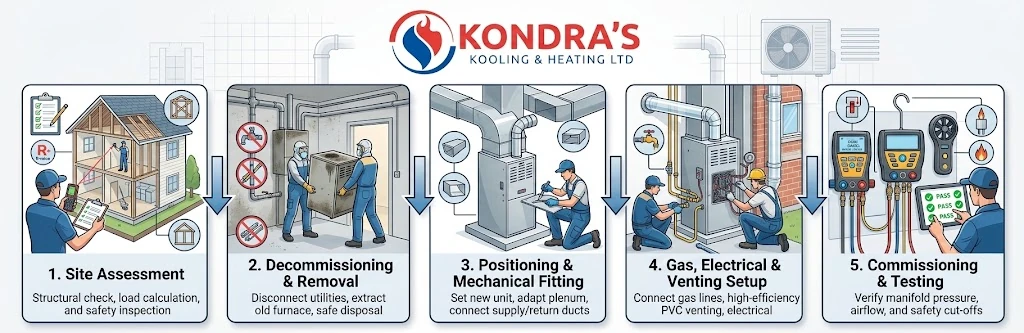
The furnace installation process is a multi-step mechanical procedure involving the removal of existing equipment, structural adaptation, ductwork integration, gas line connections, and safety verification.
Steps in a Standard Furnace Replacement
- Site Assessment and Preparation: Technicians inspect existing duct layout, gas line sizing, and electrical supply capacity. Drop cloths and protective floor coverings are positioned.
- System Decommissioning: Natural gas lines are shut off, high-voltage electricity is isolated, and existing equipment is disconnected and removed.
- Mechanical Positioning: The new high-efficiency unit is placed on vibration-isolation pads. Transition plenums are custom-fabricated to connect the new cabinet to existing ductwork.
- Venting and Drainage Installation: Category IV high-efficiency furnaces require direct-vent PVC or polypropylene piping to route combustion gases through sidewalls or roofs. Acidic condensate lines are run to a floor drain or condensate pump.
- Gas Line and Electrical Integration: Gas piping is connected, leak-tested with soap solution or electronic detectors, and low-voltage thermostat wiring is routed.
- Commissioning and Safety Verification: Technicians perform static pressure checks, test gas manifold pressure, set fan speeds, confirm temperature rise, and test carbon monoxide levels during initial firing.
Frequently Asked Questions
The average cost of a furnace replacement in Kelowna ranges from $4,500 to $9,000 or more, depending on system efficiency, heating capacity, ductwork modifications, and electrical requirements. High-efficiency modulating gas furnaces and dual-fuel heat pump systems sit at the higher end of the pricing spectrum.
A standard residential furnace replacement typically takes between 4 and 8 hours to complete. Installations requiring custom ductwork modifications, new PVC venting runs, or dual-fuel heat pump integration may require up to two full days.
Under British Columbia energy efficiency regulations, new residential natural gas furnaces installed in the province must meet high-efficiency standards, generally requiring an AFUE rating of 95 percent or higher.
Cold-climate heat pumps can serve as a primary heat source in the Okanagan. However, many homeowners select a dual-fuel setup, combining an electric heat pump with a high-efficiency gas furnace to ensure optimal performance and cost control during extreme low-temperature periods.
A high-efficiency gas furnace should receive professional maintenance once every year, ideally in the autumn prior to the heating season. Annual service ensures safe combustion, maintains operational efficiency, keeps air filters clear, and preserves manufacturer warranty coverage.